LinkedIn © 2011, LinkedIn Corporation
LinkedIn © 2011, LinkedIn Corporation
LinkedIn I'd like to add you to my professional network on LinkedIn.
- Susan Cobb | Susan Cobb
Independent Publishing Professional
Tepic Area, Mexico | Confirm that you know Susan © 2011, LinkedIn Corporation 
Thanks dear friends. Thanks dear readers. You've said such nice things about the book, and for the most part, if you didn't have something nice to say, you kept quiet. And I, for my part, have kept quiet, as well!
Yikes! I wasn't ignoring you. I didn't mean to just disappear, take my face off FaceBook, for this to become a quarterly blog. All I can say is that getting Virgin Territory to press, launching it, and then one week later having Larry go in for major back surgery -- it all got a little intense there. I became major caregiver instead of celebrated author, novice and visionary publisher.
But now, with a husband who is an inch and a half taller and the possessor of enough interior hardware to be labeled a semi-cyborg, I am ready to hit the public trail physically and internetally. (Is that a word? It should be). My inner Guadalupe has been working in secret, but she's starting to shine through the clouds. Hey, Little Darlin'! It's all right!
My manuscript is in the hands of a designer. We're headed toward publication. While we wait, I thought you might like to see... Chapter 1—Calle Sin Salida Behold, I will do a new thing; now it shall spring forth; shall ye not know it? I will even make a way in the wilderness, and rivers in the desert. Isaiah Calle Sin Salida. It was a green sign high on a utility pole at a corner where one cobblestone street met another. The plaque was framed in orange stephanotis that dripped from the electric lines like tropical icicles. Calle Sin Salida—not the name of the street itself, but rather a warning: "Street without an exit." In English, dead end. Below that plaque, there was another, printed with the actual name: Calle Golondrinas. My husband and I had been wandering through a neighborhood of bird names for streets—Pelicanos, Gaviotas, Pavo Real, Colibri: Pelicans, Seagulls, Peacocks, Hummingbirds. I'd looked them up as we went along. This street was Golondrinas: "Swallows Street." I knew that because we lived at the time near California's San Juan Capistrano, famous for its swallows and its Spanish heritage. No translation needed for us on this one. The words were neatly centered above another line of printing: "La Islita Pizza" and a local telephone number. Big cities in the States have corporate sponsors for their stadiums. Rural Mexico has sponsors for their street signs. My husband gripped the steering wheel more firmly and downshifted. Driving over cobblestones isn't conducive to conversation, and this particular street was teeth-jarringly picturesque. "Let's see how close we can get to the beach," Larry ventured. "I'll bet this road leads right to it." Not a bad bet, as shortly after the entrance to the street, we crossed a little bridge and caught a glimpse of the waves and sand beyond. We took our time, taking in the houses, the gardens, and the glimpses of bright beckoning blue between them. My surf-loving husband was on a quest to see how close to the ocean he could find a house. I was along for the ride of what I was sure was pure folly. We had spent ten days of a two-week vacation exploring the Nayarit coast north of Puerto Vallarta, playing lookie-loo with real estate agents from Sayulita north to La Peñita. We were halfway serious about buying a second home, mostly dreaming and what-if-ing. It was February 2006, and we were mostly just tired, glad to be away from the electric atmosphere of coastal Southern California. We were worn out from work that had become repetitive, and the mental tension of an election-year America polarized into opposing factions. Half of our friends were too despondent to talk; the other half, too excited and gung-ho not to stop. What an amazing change of pace we'd found 1,500 miles south on the Pacific Coast of mainland Mexico. "Changes in latitude, changes in attitude," as the song goes. Much further back in my life I'd had a brief career—six years worth—selling houses in that frenetic market north of the border. Your reputation and livelihood depended on getting back to people, the sooner the better, striking while the buyers were hot and the sellers were willing to move. Not the case in this place. We'd been trying to connect with someone—anyone—who could show us property in Guayabitos. It never happened. Left to our own devices we cruised around, assessing not only the houses to which we did manage to gain access, but our own prospects for the future. We both felt physically and mentally spent, not dead yet, but barely living. We sensed rather than knew that we'd reached a major turning point in our lives. We were ready for a change, open to it. We just didn't know what it would look like. "There's the beach," Larry announced. We had reached the end of the road and stopped in the cul-de-sac. We were facing north, and to the left of us stretched the deep blue Pacific, embraced by the long sandy arms that defined Jaltemba Bay. Smack in the middle of the bay sat a small island that looked like half an over-sized hairy coconut. Straight beyond our windshield lay a stretch of flowing water, the river dividing Rincón de Guayabitos from La Peñita. Here it entered the bay between two rock groins that stretched out into the water providing a passage for fishing boats. At the end of the groin on our side of the river, facing down the waves, there was a cross. But more than a cross. Is that a shrine of some sort? I wondered, making a mental note to check it out later. Directly in front of us, across the river were buildings. From a cantina we could hear the plaintive aaay pobre corazón music. There was what looked like a small apartment house with a palapa shade structure on top. Broadleaf guayaba trees lined a rock embankment, their deep green reflected in the water. Guayabitos was the diminutive form of the tree, or its fruit, for which the town was named. There were also palms, more shaggy fringed palapas, and ruffles of red tile roofs. If there had been a bridge, we could have crossed to what looked like an extension of this cobblestone street . Ah, but it was Calle Sin Salida. The end of the road. There was no access from here to there. The village across the water was just far enough away to be mysterious and quaint. To our right, we peered past a hedge of brilliant bougainvillea and took in the white plaster walls of what looked to be a large home. It had a scroll of an iron gate in front of a courtyard. The red tiled roof that slanted slightly down towards us was not a faraway ruffle. We were close enough to see its tip-tilty planes, topped with a big white dome pierced with clerestory windows. Rising above the dome was an honest-to-gosh cupola. I couldn't tell if the house had one story, two, three, or maybe a mixture of them all. The structure was set back from the street but at an elevation that, from where we were in the car, I could see a man sitting on what looked like a front porch or balcony. He was having a cup of coffee, looking out at the ocean—and at us. He waved. I waved back, and he rose, starting down the broad brick staircase that led from the front entrance of the house to the curvy iron gate. "I think he's coming out to talk to us!" I said. Larry turned the car around and headed out of the cul-de-sac, stopping so the man could lean against the driver's side. He indeed wanted to talk. Leaning into the window of the small rental car, he got right to the point: "You folks wanna buy a house? This one's for sale." He pointed to a small sign on the front gate, which I now remembered catching a glimpse of as we'd passed. We'd been too enthralled with the view before us to take much notice. "Hmmmm. Maybe." Larry was non-committal. We'd been around the area. We knew the prices. This house looked way out of our league. The guy named a price. We were right. Definitely more than we wanted to spend for a second home. I said so. Not to be put off, he asked, "Where you folks from?" "California," I responded. "San Clemente." "Us, too!" He waved toward the house, indicating someone else inside, and reeled off an address. It was about two miles from where we were currently living in the States. "Left about sixteen years ago. Own your home there?" I knew what was happening. We were being pre-qualified, but it was gentle, friendly. I had the feeling we were in the hands of a master. We talked about San Clemente and its neighboring towns of Dana Point and San Juan Capistrano, living near water, when was the best time of year, when was it lousy. Ultimately—who could resist his invitation "come on in and have a look"? No longer was he "a guy." He was Jim. Right from the start, we knew this was not your bare-bones tropical resort-style residence. Mexican modern it was not. Well over thirty years old, the house was venerable for the area, with construction details that spoke its age. Walls almost a foot thick splayed into even larger footprints below in the basement. Well, it wasn't really a basement. The bottom floor of the house was only half underground. This is what gave it a higher elevation than its neighbors, and accounted for the broad sweeping staircase leading up to the main entrance. What was below was a subterranean red-tiled space that wandered like a great cavern under the entire house. At present it was packed solid with "a few of our things," Jim said airily. But we could see there was ample room for multiple vehicles, a laundry room, a workshop/tool room, a garden supply area, a place for pool equipment, and lots of storage area left over. But it was the house above that worked its magic on us. One pass through it, and Larry and I had a sneaky suspicion. No, it was a conviction. This was it. First of all there was the kitchen. It was spacious, and at one end French doors opened street side onto the small balcony/porch where I'd first seen our "guy." I wanted to sit there, too, and watch the world go by. Inside there was a breakfast area and a large tiled island supporting a six-burner gas range and room enough to set up a buffet meal. Along one side of the room, the counter holding the sink and prep area looked out across the river to the inaccessible village. The other end of the kitchen was defined by a bank of dark wood cabinets, a deep pantry and open shelves. "Huanacaxtle wood," Jim explained. He stroked the pantry door. "Absolutely termite-resistant." There was more of it through the house: solid-core raise-paneled doors opened to high-ceilinged rooms. Dark louvered doors hid closets and cabinets. This house had storage! There was a pervasive formal air, a colonial sort of elegance that spoke brandy snifters rather than margaritas. We stopped near the tiled alcove in the front hallway. I looked puzzled. Why would anyone put a sink here? As if divining my thought, Jim explained. "Guy that built the house had a few little quirks. He was a television producer. Came up with some game show that really hit it big. Had an eye for details, though. Some of them are a little screwy." Our flip-flops slapped against cool ceramic tile floors, a mottled pattern that resembled white sand at low tide. Above, red brick boveda ceilings arched gracefully at varying elevations, sometimes bursting into glorieta designs where the walls were curved. The ceiling in the kitchen rose to a peak of over twelve feet above the tile-topped island. One in a spare bedroom hovered over a reading alcove at a much cozier level. There were niches and crenellations and unexpected angles and curves wherever we turned. The interior should have been dark, but it wasn't. Right in the heart of the house there was a great open roundness filled with light. The cupola room sat directly beneath the tiered dome that had caught our attention from the street. Post-meridian sunbeams skittered across the tiles and splashed up on white plaster walls. Intuitively I knew the potential of this space. It should be filled, but with what, I wasn't certain. For now it was completely empty, a glorified hallway between the entrance and the verandah beyond. Had Jim and his wife ignored this room because it had no view to the outside? I looked up at the clerestory windows that admitted the sunlight. I could imagine looking at the moon through those windows. This was a room for reflection in every sense of the word. "It's like a house in a mystery story," I breathed aloud. "Oh, it's a house with a history, all right," responded Jim quickly. He was a little hard of hearing. "It was built by that TV guy, and he sold it to a drug lord. That guy was shot right here in the living room. His best friend and partner did it. He's in prison now. The next guy who bought it was a soldier of fortune. He found a stash of $40,000 in the ceiling there above the hallway. Probably drug money. Come on through to the back. I'll show you where they used to toss the sacks of drugs from the estero, over the wall into the swimming pool." Was he kidding? Larry and I looked at each other and followed wordlessly. The first thing we saw behind the house was not the swimming pool but the river. Here, obscured from the street by the house, the river split, forming a tree-covered island that sat a stone's throw off the back of the property. Reflected in the water was a flock of white egrets settling in the palms that studded the islet. From the verandah where we stood, a flight of stairs led downward to a blue-tiled swimming pool, just steps from the back of the house. Beyond that there was a broad deck, an open barbeque cabana, and a low iron rail fence built back from a rock embankment. "I built the deck and cabana," Jim said proudly. "Also that rock wall between here and the river. Carried those stones out of the mountains. Before, there was a concrete wall right up next to the pool. About eight feet tall. Made it really private, but blocked the view. I guess there was a reason, though. The speed boats would come in close after dark, and up and over the walls would go the bags—right into the pool." "Bags of what?" I asked. "Marijuana? Opium poppies?" The hills of rural Nayarit would seem to lend themselves to all manner of illegal agriculture. "Oh, I'm not sure," Jim hedged. "Marijuana, maybe. Maybe money! I don't know how they worked it. Just know the guy who lived here, that was his business." Jim's story obviously had a few kinks to work out. I thought he probably told it strictly for the romantic cachet it lent to his pitch for selling the house. The pool was large but so close to the house we couldn't see it when we sat down on the verandah half a story above it. I could imagine diving directly into it without even having to go outside. It was inviting, but not enchanting. It was the verandah itself that worked its spell on me. Ten feet deep it stretched across the rear of the building. It was cool, private, and shielded from the afternoon sun. Two ceiling fans kept the air moving over tropical furniture beneath. I half-expected to see Somerset Maugham rise and greet us. The curve of the river seemed to embrace the house. Where drug runners may have plied the water, now there were fishing skiffs that zoomed around the island and skimmed the surface of the river directly behind the back fence, startling the egrets, as well as pelicans and roseate spoonbills from their own fishing business. They rose in squawking clouds of protest each time it happened. Across the length of the verandah, four deep-silled arches framed the view. I mentally stuffed them with potted geraniums. From a swinging hamaca chair, I would be able to see it all: estero, palms, hills in the distance with the suggestion of structures and civilization. And behind it all lay the backdrop of mountains. I knew those mountains. I tend to anthropomorphize landscapes, and I like to know the given names of topographical features. It's like knowing who your neighbors are. These mountains were the Sierra Vallejo, a small chain of the grander and more extensive Sierra Madre Occidental. Sierra Madre: Mother mountains. The double peaks of the Sierra Vallejo rise behind Guayabitos, like Saddleback Mountain rises over South Orange County, California. I'm not the only one prone to anthropomorphizing land forms. I was to find out later that local fishermen call the Sierra Vallejo "Dolly Parton," a much more descriptive term. I could relate. Twenty years before, we had moved from the flat plains of West Texas to the area around San Juan Capistrano. I nestled into the foothills of that sierra like a child at its mother's bosom. But life around Saddleback Mountain had become hectic and harried. I no longer had time to nestle. Here, with nature literally at my doorstep instead of far beyond some freeway, I was ready to nuzzle in and be nurtured. Jim knew how to talk a good story. He also knew when to fall quiet. For a while we sat in silence, listening to the birds, the fishing boats, the sound of traffic from the distant highway, the thwump, thwump of the ceiling fans above. Gradually I became aware of another sound, an underlying rhythm. It was not as pervasive as the freeway noise that enveloped our house in California, but it was definitely a presence. Resonant, it wrapped the whole house like a rebozo wraps a baby. I listened to identify it. Surf! Out of sight here at the back of the house, the ocean still made its presence known, constant as a heartbeat. Throbbing. Continuous. Consoling. "Nestle in," it seemed to say. "Be safe. Be still. You're home." The conversation Larry and I had that night was basically a mutual confirmation of what we both knew we were going to do. No second home, this house on Calle Golondrinas. It was home. "We'll take it," we told Jim the next day, and we wrote out a sales contract on a yellow legal pad. Calle Sin Salida may have been a street without an exit, but for us, it looked like a way out.
 December 12 is el Dia de la Virgen, however the celebrations begin the evening of Dec. 11 at sundown and last through the night, until dawn. We were invited to follow our host's pick-up through the jungle, into the mountains to the 'rancho' (small mountain town) to join the all night festivities with the family of our goddaughter's mother. It turns out this family comprises at least 80% of the town, with parents, grandparents, children, cousins, nieces, nephews, aunts and uncles all there. Everyone seemed related to someone else.
The town boasted a new and sparkling clean main plaza nestled between the town's two streets, with the also clean and new church across from it. Some of the townspeople were finishing up the last of a coat of paint on the plaza's (dry) fountain as we arrived. A shrine to Our Lady of Guadalupe was set up in the plaza, adorned with balloons, flowers, candles, palm fronds. The church was also festooned with flowers, and flashing Christmas lights of all colors surrounded the Virgen on the alter. Some people were in the church attending mass, others just sitting around in the plaza, and we three American women were welcomed by all the town, especially the curious 8 - 10 year old girl cousins, who soon became our fast friends.
After the mass, a procession descended from the hillside, each person holding aloft a candle. Then the musicians arrived with their violins, guitars, and later a bass. The music began, the older women fell into parallel lines facing the shrine in the plaza and their intricate, winding dance began. It would continue all night. The explanation given us is that the Virgen watches over us all day, all night, every day, every night. On this, the eve of her day, the people stay up with her, offering her their music, their dance, their devotion. We sat on the edges of planters watching the dancing, listening to the music, occasionally wandering around, talking to the other women, the girls, watching the small children running about and chasing each other. And the firecrackers!! How the Mexicans love their firecrackers, the louder the better, and what is a holiday here without them?! Every half hour, if not more, they would go soaring into the sky and explode with a thunderous concussion.
At about 8:00 in the evening the food was served - beans, meat in a rich, oily, spicy broth, and a carne asada, which, we were told, had just been slaughtered that morning for the feast, and was grilled on a Weber BBQ. And of course, piles of tortillas. The dancing continued, the lines getting longer as more women, teens, and some of the men joined in. The children became sleepy and lay down on blankets their mothers had brought, on the cement of the plaza, in the open night air. Huge pots of sweet, weak coffee laced with cinnamon were kept warm over a wood fire and a drop of tequila would be added if you wanted. All the women shared in watching over the children - some mothers danced as others nestled their little ones and wrapped them in blankets. A small girl, maybe one year old, dipped her fingers into my plate of beans. I fed her small pieces of tortilla and bits of meat and she then became 'mine' for several hours, finally falling asleep in my arms as I rocked her to the sweet music.
And then the 'toro' appeared. This is a paper mache bull with fireworks attached and is held aloft by one of the men who goes running around the plaza with fireworks spiraling off in every direction, chasing anyone who runs from him, which of course Susan & I did, much to the amusement of our friends.
We had been lead to believe that we would be spending the whole night there, holding vigil, but our family decided to leave at about 10:30 for the hour and a half drive back to La Penita, so we followed them out through the jungle, arriving at the La Penita plaza at midnight, finally falling into bed at about 2:00, to the sound of the fireworks which continued until dawn.
 Catrina is the skeletal feminine figure that presides over Dia de los Muertos, and this young woman was getting into the spirit of the holiday. She is not, as several people observed, all that "skeletal" herself, but she's got the traditional hand-on-the-hip Catrina pose down pat. The official observation is on November 2. It falls on Monday this year, and we will be celebrating with neighbors and friends at the formal opening of Xaltemba Restaurant and Gallery. But last night Larry and I, and houseguest Patricia, strolled up and down the main Avenida, taking in the altars built by local high school students to honor members of the community who had made a difference in their lives. There was an altar to a former math teacher, and several to grandfathers and grandmothers, those altars readily apparent by the presence of a rocking chair waiting to rest their weary spirits.  It's at this time of year that supposedly the dead come back to call on those they've left behind, and they're greeted with ofrendas or offerings of things significant in their lives -- favorite foods, treasured mementos, symbols of activities they enjoyed, or symbols of their employment. The woman honored by this altar was a hair dresser, so you see her salon chair, a hair styling magazine and other tools of her trade -- all ready for her return.  The majority of the altars honored young people -- friends, classmates, or older brothers or sisters of the students' contemporaries. You see a date like the one in the picture, look at the young face framed by a sunset over the ocean, and catch your breath. Not even twenty years old! Obviously Alejandro, another nineteen-year old, was someone who loved the water, and his friends decorated his altar with lots of beach sand, and even provided a skim board for playing in the waves. (Remember, you can click on any image here and make it bigger. Then just hit the back arrow to return to the text.) 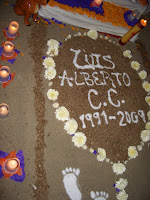   Do people really believe the spirits come back and visit? Talking with our Mexican friends, and with the young people busily constructing the altars that afternoon, I get the impression that these memorials are more a means for keeping those who have passed on alive in memory rather than a serious accomodation for the departed returning in some kind of not-so-concrete form. What is very tangible though, is the sense of reverence and remembrance for the person being considered -- a public acknowledgement of his or her value and contribution to the fabric of community life. I like it that high school kids have an opportunity to come together, build something around a friend's memory, get dressed up, read aloud a tribute, and have people applaud afterwards. That's the kind of validation every teenager could use. Essential to every altar are four elements: - An image of the person honored
- candles for light and aroma
- fresh flowers to remind us of the impermanence of physical life no matter how beautiful it seems
- water to symbolize purity and renewal
I don't believe in spirits other than the sense we carry around of who someone was. Goodness, that could apply to those whose warm skin we can still touch! It's our own sense of who our mother or dad was -- or is -- that may affect the way we conduct ourselves now. My mom lives in Lubbock, Texas, but I swear she spends a lot of time inside my head. There are ghosts to deal with, living or dead. If building an altar and revising our mortal history can expunge a few hurts and misunderstandings, I say, "lift those altars high!" Let's honor the good and let go of the not so good. That way Dia de Los Muertos becomes a celebration of life, the way it was meant to be!
That's counsel from Nora Ephron – or at least from her mom to her. It's advice for those times when Life with a capital L for LIVING, LOVING, and LAUGHING, seems to diminish into life -- little, limited, frightening, painful, and frankly depressing. As much as I would love to stay in the mental space where I see myself as a dancing column of light, there are times when dust motes invade, tears come, and waddaya got? Mud.
But the light is breaking through and it's time for Plan B – or C, D, or XYZ. Whatever. I'm not giving up. Those dust motes are turning into grit.
When you start writing a book, it's nice to know where you're headed with it – what the ending is going to be, how the story will resolve. Getting there is what makes the story. It's like the road from Guayabitos up to Tepic, the capital of the State of Nayarit, where we live. It is a windy two-lane asphalt ribbon that holds surprises at every turn. During the journey the compass on Hummercita literally goes full circle. But I know we're headed to Tepic, no matter what direction we seem to be going at one particular moment.
I kept that in mind last week as Larry and I drove there, and I checked into the San Rafael Center for Surgery. I'd gone there for "a study." I ended up staying several days and having some "serious" surgery. The anesthesiologist was named Filiberto, and he called me "Susanita la Bonita." He comforted me as the surgeons around me prepared, telling me about his home in the mountains and showing me photos of his two Huichol wives on an iPhone. "I've slipped a little peyote into the magic serum," he winked at me. "You will have beautiful, colorful dreams." I think he was joking. But whatever, the events of the last two months are receding into dream like status, maybe not beautiful nor colorful yet, but at least not frightening.
I'm back. I took notes. And Virgin Territory is going to be a great story.
After two weeks in Texas and Oklahoma visiting friends and family (90 showed up for the reunion), I'm happy to be back in hot and humid Mexico, with a good excuse to stay sequestered. Working, working, working -- after a brief almost disastrous flirtation with Bejeweled. Acchh! Run away from that game! It's seductive and addictive! Looks like there's interest building in our friend Mary and the Virgin of Guadalupe. Here are a couple "signs of the times."New movie about Virgin of GuadalupeNew move titled Mary, Mother of ChristDid you get that, that I said AND the Virgin of Guadalupe? They are not necessarily one and the same! Want to know more? Read the book!
 The weather has cooperated. It's so blistery hot no one dares stick their nose outside. So I've been cloistered away writing, writing writing on Virgin Territory. It's close enough to finished to say almost done. I'll get the big working document printed off once more and in a binder to carry with me to Texas and Oklahoma these next two weeks. I leave tomorrow to see Mom and family. But that manuscript will be my constant companion as I edit, edit, edit. So I'm going to stick my neck out once more and make my plans public: I want to get this into print so I can introduce it at the Guadalajara International Book Fair, November 28 - December 6. There! Hold me to it, Friends. Your support has been SOOO helpful. The guest of honor this year is the City of Los Angeles. This is such a natural! Read more about the fair here at Wikipedia. So that's me celebrating a little early last Saturday night. Eddie and Roberto are opening Xaltemba for two Saturday nights, to give their new chef a little try out. There were nineteen reservations this past Saturday, and forty people showed up. Whew! Talk about crunch time! Check out their menu for this coming Saturday and eat your hearts out, you fair weather amigos who have fled north! Larry surprised me that evening with a banner wishing me "Feliz Cumpleanos," and a chocolate birthday cake, which we parcelled out among all the people present. My friend Ann painted me a birthday card, bought me a crown (Ann, I'm still waiting for those photos!), and wrapped everything up in Quincianera packaging. She just put a great big "X 4" in front of all those number 15's. Every girl should get a crown sometime in life, and I say, better late than never! But the real crown in a woman's life is a group of special friends wherever she finds them, and mine were at breakfast this morning. Our Tuesday morning ladies' breakfast club at Irma's La Casita has not dwindled with the heat. The group has grown larger and more devoted to getting together than ever. It may be a hot weather thing, but for some of us, this is the highlight of the week! So thanks Piedad, Lupita, Elizabeth, Melanie, Sarah, Jane, Linda, and Trish, for your birthday greetings and goodies this morning. And Jeanie, Barb, Marilyn, Lin, and Ann, we missed your smiling faces. I'm off to pack up and go. Hasta pronto, ya'll.
 I've been spending today with Sor Juana Ines de la Cruz. I can't believe I carried away a degree in Spanish and Latin American Area Studies and never got to know her better. The textbooks I studied described her briefly as a nun who wrote a lot. That says something about the state of university curricula prior to the emergence of women's studies.
Juana Ines de Asbaje y Ramirez was born in New Spain (now Mexico) around 1651. She learned to read when she was three years old and wrote her first play at the age of eight. She mastered Latin in twenty lessons before becoming a teenager. When she was fourteen, she became a maid of honor to the wife of the Spanish Viceroy in Mexico City, and delighted the court with her erudition and learning. But at twenty-one she entered a convent because in order to continue her life of writing, musical composition, scientific and mathematical studies and vast correspondence with the other literary lights of the day, that was the only option available to her. That's when she became Sor Juana Ines de la Cruz.
For the next twenty years she wrote prodigiously on theology, mathematics, and philosophy, which brought down the anger of the church hierarchy for dealing with subjects outside of the purview of women. But she also wrote about love, rapturous, passionate works of poetry and prose. Her most famous work was a response to the bishop at Puebla who was supposed to be her friend. He had written in subterfuge, disguising himself as one of her sisters in the convent, and advising her to leave off her studies, not to meddle in the affairs of men, and to devote herself to the religious life. Her Respuesta is a classic text in defense of woman's intelligence and the right to education.
She died in 1695 during a cholera epidemic. Shortly before her death, she had sold her library of over 4,000 volumes and given the proceeds to charity. What remains of her writings is contained in three large volumes, though it is agreed that the majority of her prose work, aside from her Respuesta, was lost or destroyed. Her image is perhaps in greater circulation than that of Guadalupe, as it is imprinted on the 200 peso note. Before the last devaluation, she was on the 1,000 peso note. Sor Juana is definitely a trail blazer in Virgin Territory.
 On Friday last week, Larry, our houseguest Patricia, and I escaped from the coastal heat to a little corner of paradise tucked up in the mountains between Tepic and Guadalajara. Santa Maria del Oro looked like an interesting little town, but not interesting enough to keep us from forging on through it to the lake beyond and below. First we stopped to look at it from above, then we drove down the narrow winding road to the lake itself. The drive around the lake is something I'm glad we did, but happy we don't have to do again. The road is pretty rough, and sometimes practically disappears. Maybe people get to those big pretty houses by boat rather than car.  We settled in for lunch at one of the shore-side restaurants. We settled in for lunch at one of the shore-side restaurants. It wasn't exactly crowded.
But there was a floor show -- one lone water skier who made pass after pass doing a flying flip on a wake board to our applause and cheers.
The temperature said 85, but with the humidity down in the 30% range it felt cool and pleasant. Santa Maria del Oro is just 40 minutes east of Tepic, even on the free road. I would think there would be a lot of visitors from there, but on that day we had the place practically to ourselves. Here are a couple of links that have more photos and info.
The air is so heavy you need to drink it rather than breathe it. But, hey it's cloud cover. I headed for the market just to get out of the house and to buy some ceviche for lunch. On the way out, I saw the caretaker, Regino, applying herbicide to the sidewalks. (Never mind the streets. They're green already). He had a face mask, a hoodie, and a big glove on the hand that held the bottle of poison. "Pareces como Michael Jackson!" I called to him from the window. He waved back and did a little jerky dance. "Mas o menos!" he agreed. Ah, Michael, You're everywhere.
The concert in Puerto Vallarta was a production of Televisa, and they went all out on the staging and publicity, if not porta-potties. Conversation around tables here in Jaltemba has revolved around "where we were" during the concert. Several good reports, but the most lousy experience goes to Cate and her crew who were out on one of those little boats in the choppy, choppy waves. Here's Televisa's take on the whole thing. It's long, but you only have to watch a few opening minutes to get the flavor of what was going on in and around a concert production they said attracted between 80,000 and 100,000 people. Check it out here.
And we're so glad it didn't! Larry and I stashed patio furniture cushions, strapped down hammocks, collapsed umbrellas and evaluated which potted plants might prove lethal if left on walls or tables. In Puerto Vallarta, windows at the Liverpool center were either boarded up or taped with big crosses. Sandbags were strategically placed across doors and drives. If we know anything in Mexico these days, it's how to respond publically to a crisis.But it was officially beautiful yesterday with the remnants of what turned out to be a benign tropical storm swirling through the sky. There was enough rain over the last few days that the river behind our house broke through the sand bar which builds up across its mouth each year during the dry season. The green waters have escaped and we now have a tide-sensitive estuary. The egrets have returned, and the setting sun which broke through the lead belly cloud cover for a few brief glorious moments before sliding below the horizon gilded their white breasts as they veered up and over our heads. Sort of breathtaking.There's still quite a gringo contingent in the Jaltemba Bay area, and those that are left are using the quiet time to throw themselves into creative efforts. Lin is building another suite in her bed and breakfast while a local artist is covering her walls with murals. Roberto and Ann are painting, painting, painting, except when Roberto is cooking, cooking, cooking. Eddie is showing up like clockwork at Xaltemba, as if it were an office job, coming up with new restaurant concepts for next year. Dennis is putting his talents as a former baker for Sara Lee to good use -- we love to have him show up early in the morning with fresh bread or sweet rolls. Chuck is in the home stretch on the house he's building on Sol Nuevo -- it gets fancier and fancier with every new design concept Wendy comes up with. And I have more and more pages to print out and punch. My loose leaf binder manuscript is growing at a slightly faster pace than the six two foot high Italian Cypress I planted last month in hopes that they will shade our pool by next summer. So saludos to our friends up north. Hope you'll have as much to show for your summer time as we here in Virgin Territory.
So there were masses of people, lots of rain, a starting time that was an hour and half late, and a sound system that would dissolve cobblestones. And Larry says I don't know how to have a good time. I could go into detail, but do you really want to know?? Maybe it's an age thing (ya think?), but I don't believe I'll be going to many more mega-star-all-for-TV-and-live-audience-be-damned productions. One in a decade or two is plenty. The company I was in, however, was delightful. The borrowed condo down near Mismaloya sublime, Friday night's dinner intimate, air-conditioned and delicious, and Saturday's outing to the botanical gardens a little piece of heaven. Happy to be back home today. Back to writing tomorrow!
"I'm so grateful you have friends to go play with." This is my husband over fresh orange juice this morning. He's referring to my heading off to Puerto Vallarta this weekend to participate in a mega event designed to boost Mexican tourism. Alejandro Fernandez, resident of Puerto Vallarta, is bringing a few friends (Gloria Estefan, Enrique Iglesias, et. al) to give a free concert on the Malecon Saturday night. Click on his name to get a little taste of what you can hear as background music in most romantic mood restaurants in Mexico. And here's another sample of a wonderful way to learn the more complicated Spanish verb forms -- Si tu supieras (If you only knew.) Oh, and what the heck, here's one more -- En el jardin. Que les guste! Enjoy!
I'm launching this blog to support the book I will have written by the time I turn sixty. That is next month, July 21, 2009. It's almost done. I'm calling it Virgin Territory. Let me tell you about it.
In February, 2006, my husband and I sold everything we owned in the States and moved to the Pacific Coast of Mexico just north of Puerto Vallarta. It was a decision made in a burst of either madness or inspiration, a precipitous plunge into retirement -- and renewal. For us, like thousands of other gringos making this move, Mexico represents a new beginning. In that respect, where we now live is definitely "virgin territory."
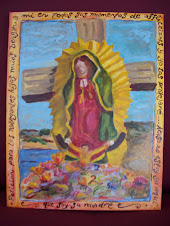
But Mexico is also the home of Our Lady of Guadalupe, "Goddess of the Americas," an indigenous icon that has been growing in presence and influence both north and south of the border. Her image graces more rearview mirrors, notebook covers and shopping bags than it does church altars. The Virgin of Guadalupe represents a popular religiosity unconfined to any institution, and now, in a time when institutions of many kinds seem rather shakey, she provides a spiritual perspective on what is lasting and important. She is a current symbol of an ancient ethos, a direct encounter with what is colorful and primitive, free-flowing and spontaneous, yet constant and sustaining.
It is my hope that Virgin Territory will speak particularly to women who are ready to move – if not physically, as in Eat, Pray, Love, then mentally – to consider new ways of being present with God, with themselves, and with others. Like Barbara Brown Taylor, they may be Leaving Church. Like Sue Monk Kidd, they're looking hard at religion's traditional authority figures – and often finding them lacking. Like Anne LaMott, they may cast a sardonic eye at social norms and politics, and find refuge in a more primitive Christianity full of grace and humor.
After our move to Mexico, I found myself taking a fresh look at The Virgin of Guadalupe. I'd first had contact with her when I was eight years old and I visited Mexico City with my family. She'd made a lasting – and largely erroneous – impression on me then. Now, over fifty years later, I find she represents far more than I'd ever imagined. To me she is the archetypical feminine spiritual ideal featured in Mary Baker Eddy's major work, Science and Health with Key to the Scriptures, an archetype which I now feel impelled to "unpack" and bring forward to the twenty-first century. The Virgin embodies qualities that humanity needs now, a fresh model of divine expression that goes beyond the confrontational and competitive our-God-is-bigger-than-yours prototype.
What provides the story in Virgin Territory is that the spiritual perspective I've gained from this feminine model has proved practical during our time here. We renovated a house bought on a whim. We had personal health crises and coped with the fraudulent loss of our retirement nest egg. I came to terms with a long-suppressed childhood trauma, discovered talents and artistic inclinations I never dreamed of, and regained a sense of life-purpose and identity beyond a religious denomination, a family name, or a particular nationality. Through it all I became more intimately acquainted with an underlying gentle Mother presence, and began seeing myself as Her reflection. It's made a huge difference in my life, and I think my experience might be helpful to others.
|
|
|
|




 Posts
Posts